
Sensory room brings comfort to ADP clients
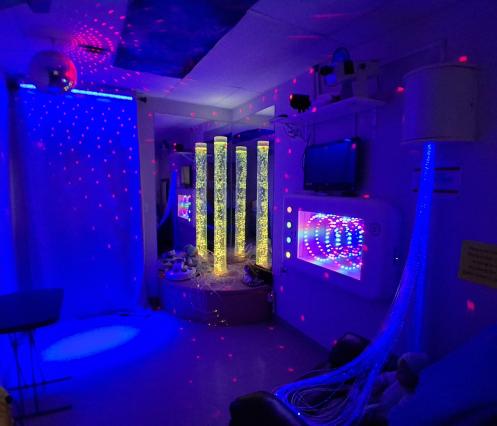
When clients of VON Middlesex Elgin’s Adult Day Program (ADP) need a quiet moment away from the group, they can find comfort in the program’s “Snoezelen room” — a calming sensory space designed to promote relaxation and reduce overstimulation.
The Snoezelen room supports clients living with dementia and others who may benefit from a quieter, more individualized space. The Middlesex-Elgin ADP can host up to 18 clients per day in addition to staff, and for some clients, having access to a quieter environment can make a meaningful difference. “The room offers a peaceful alternative for those who may be experiencing feelings of overwhelm in the larger group setting,” said Meghan Lee, ADP supervisor.
Middlesex-Elgin’s Snoezelen room was created in 2014 after VON received a grant from the Wilf and Jean Bell Foundation. “We are very fortunate to have it. Not all programs have a space like this, and it has made a huge difference for our clients overall,” said Meghan.
The dimly lit room features bubble tube lights, a comfortable recliner chair, and a touchscreen projector that displays calming visuals and light shows, as well as smaller items that can be held by the clients. Recreation therapists work closely with clients to determine which sensory elements may be most beneficial and can tailor the experience to individual preferences.
The term “Snoezelen” originated in the Netherlands in the 1970s and combines the Dutch

verbs “snuffeln” (to seek and explore) and “doezelen” (to doze and relax). While the concept was first created to provide people with cognitive disabilities a multi-sensory environment, it quickly evolved and expanded globally, and is now used in dementia care, autism therapy and neuro-rehabilitation.
The Snoezelen room aligns with Montessori-based approaches to dementia care by encouraging comfort, independence, and meaningful engagement. Sessions in the room can last anywhere from five to 45 minutes, depending on the client and their needs. And while sensory rooms are not effective for everyone and can occasionally feel overstimulating for some individuals, many clients leave feeling noticeably calmer and more relaxed.
“If someone leaves the room calmer than when they entered, then we know it helped,” said Meghan.